The Real Story Behind the Munster Home: A Hollywood Legacy
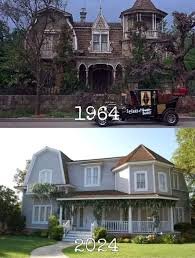
The Munster family’s eerie yet iconic home, with its gothic spires and oversized windows, stands as a symbol of 1960s pop culture. Famously known as the Munster house from the beloved television series The Munsters, the residence has a fascinating and intricate history that is intertwined with Hollywood’s film and television legacy. This story begins not in the fictional world of Herman and Lily Munster, but in the actual backlot of Universal Studios, where it started life as a prop for a different production.
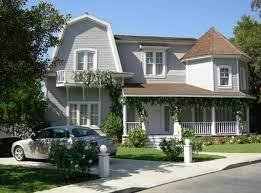
The Origins of the Munster Home
In the 1940s, Universal Studios was a powerhouse of Hollywood filmmaking, contributing countless classics to the silver screen. At the heart of its soundstage was Stage 12, a space that would play a crucial role in the creation of some of Hollywood’s most memorable properties. In 1946, Stage 12 became the backdrop for So Goes My Love, a romantic drama starring Don Ameche and Anita Louise. During the filming of this movie, Universal’s set designers constructed a picturesque yet oddly haunting house that would eventually become the Munster home.
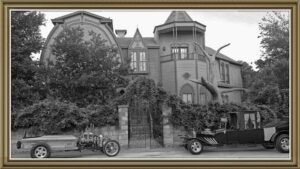
This house, originally called the “Maxim Home,” was a gothic-style mansion, designed to give an air of romantic nostalgia while still evoking mystery and drama. The house’s imposing structure, dark wooden beams, spiky rooflines, and sprawling front porch were meant to capture the attention of viewers and fit into the tone of the film. However, unlike many film sets that are quickly dismantled after the conclusion of a production, the Maxim Home was not taken down after So Goes My Love finished filming.
Instead, Universal Studios decided to keep the home, along with several other sets, as part of a larger collection of props that would be re-purposed for future productions. What was once a temporary film set became a permanent part of the studio’s backlot, set against the backdrop of Colonial Street, an iconic part of Universal’s outdoor lot, where numerous famous television and film homes were situated.
Colonial Street: A Hollywood Landmark
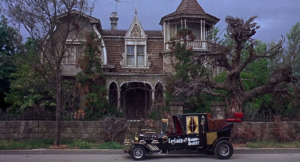
Colonial Street was a key feature of Universal Studios, with many of its homes and buildings being used in a variety of film and television productions. The street gained recognition as a “Hollywood backlot staple,” with structures designed to be repurposed in multiple projects over the years.
In addition to the Maxim Home, Colonial Street was home to other beloved television residences, such as the house from Leave It to Beaver, another classic American sitcom. The properties on Colonial Street ranged from traditional American homes to more fantastical and whimsical dwellings, allowing the studio to meet the needs of a wide range of genres. These houses were ideal for television series, allowing producers to save time and money by reusing sets instead of constructing new ones for every show.
By the time The Munsters was being developed in the 1960s, Colonial Street had become a true cornerstone of Hollywood’s backlot scene. The street was the perfect location for the fictional Munster family’s home, combining the eerie atmosphere of the Maxim Home with a charming suburban feel that was both familiar and unsettling. For The Munsters, the house would be transformed to match the needs of the quirky show, which revolved around a family of lovable monsters trying to fit into a typical American neighborhood.
The Munster Home on the Small Screen
In 1964, The Munsters premiered on CBS, capturing the imagination of audiences with its unusual premise. The show revolved around Herman Munster, a Frankenstein’s monster-inspired patriarch, his wife Lily, their son Eddie, and the rest of their oddball family. The series combined family-friendly humor with macabre elements, drawing comparisons to The Addams Family, another sitcom about an eccentric family. But the Munster family’s home was just as much a character in the show as any of its human or monster cast members.
The Maxim Home, by then located on Colonial Street, became the Munster mansion. Its imposing and dramatic exterior was a perfect fit for the show’s strange family, and it was immediately recognizable to fans of the series. From the moment the front gate opened on the screen, revealing the towering structure, audiences could sense that the Munsters were not your typical American family.
The house featured various elements that became signatures of the show. The pointed spires on the roof, gothic-style arches, and heavy wooden doors made it an imposing structure, yet the home’s cozy interior was filled with eccentric details that made it feel welcoming. Whether it was Grandpa Munster’s laboratory or the unique furniture that adorned the living room, the Munster house was as full of character as the family that resided there.
Interestingly, the home was not just used for the exterior shots of the show. The interior of the house was also constructed on the Universal backlot, with sets that were designed to match the unique aesthetic of the show. While the home on Colonial Street may have provided the framework for the exterior shots, the show’s production team built a separate indoor set to represent the interior of the Munster home. The result was a seamless transition between the outdoor location and the various interior spaces.
The Relocation and Remodeling of Colonial Street
As the years passed, the Universal Studios backlot began to change, and many of its iconic sets needed to be relocated or remodeled. In 1981, Universal Studios made the decision to move the entire Colonial Street set, including the Munster home, to a different area on the backlot. This was part of a broader effort to update the backlot’s layout and create more modern sets.
In addition to the relocation, the homes on Colonial Street, including the Munster house, were remodeled. The renovations were intended to maintain the look and feel of the classic properties while also updating them to fit into the evolving needs of modern productions. Despite these changes, the Munster house retained much of its original charm, continuing to serve as an important piece of Hollywood history.
Though The Munsters was no longer on the air, the home remained an iconic part of Universal’s legacy. It was still used in various television shows and films, making occasional cameo appearances in pop culture. For many years, fans of the show would visit Universal Studios’ backlot and catch a glimpse of the famous mansion where Herman, Lily, and the rest of the family had lived.
The Munster Home Today
Today, the Munster home continues to be a cherished part of Hollywood’s rich history. It remains one of the most recognizable film and television sets ever created, even if the show itself only ran for two seasons. The house has been the subject of nostalgia, with fans around the world celebrating its connection to one of television’s most beloved families.
Although The Munsters is no longer being produced, the legacy of the Munster home endures. For years, the Universal Studios backlot has welcomed visitors who want to catch a glimpse of the house and experience a piece of Hollywood history. The house itself may no longer be used for new productions, but it remains an enduring symbol of the creative and whimsical spirit that has defined Hollywood for decades.
Conclusion
The Munster house is much more than just the setting for a famous TV show. Its roots trace back to the Universal Studios lot of the 1940s, where it was built as the Maxim Home for a film. Over the years, it became part of the iconic Colonial Street, hosting beloved shows like Leave It to Beaver and later The Munsters. Its enduring legacy speaks to the craftsmanship and creativity that went into the design of these sets, as well as their impact on pop culture. Even after all these years, the Munster house remains a symbol of the magic of Hollywood—a place where both the weird and the wonderful are brought to life for all to enjoy.
Leave a Reply