I. A Legendary Finale: The Ambush on U.S. Highway 99

On a warm, late-spring afternoon—May 23, 1934—Bonnie Parker and Clyde Barrow journeyed along a rural stretch of U.S. Highway 99 near Bienville Parish, Louisiana.
Their car of choice: a sleek, black 1934 Ford Model 18 Deluxe V8—an automobile that was both emblematic of its era and crucial to their notorious escapades.
Clyde’s love affair with the Ford V8 was no mere fascination—it was pragmatic admiration. The Ford V8, with its groundbreaking flathead V8 engine, offered power that far outstripped the common four‑cylinder vehicles of the time.
Coupled with its reliability and Ford’s expanding service network, the car had quickly become a favorite among thieves and lawmen alike. Clyde appreciated how the V8’s power allowed them to outpace or elude police vehicles—until that fateful day on Highway 99.
II. The Ford V8: Engineering Marvel & Symbol of the Era
To understand why the Ford V8 became such an icon for both outlaws and police, we must examine the car’s technical brilliance and symbolic weight.
A. Technical Innovation
-
Flathead V8 Engine
Introducedby Ford in 1932 and perfected in 1934, the flathead V8 unleashed 65 horsepower (later 85 horsepower with optional upgrades) from a compact, lightweight design. Performance was revolutionary for its time. -
Robust Chassis and Design
Known for its durability, the Ford’s frame and suspension were well-suited to rough dirt roads—common across rural America. Its aerodynamic body and powerful engine sequence ensured speed and stability. -
Affordability
Ford’s mass‑production meant the car was priced low enough to be within reach of working-class buyers. For criminals, this made it a discreet yet high-performance investment.
B. Symbolism
-
Modernity in the Depression Era
Despite widespread economic desperation, the Ford V8 symbolized hope and progress—a rolling testament to technological advance. -
Dual Identity
The same car appeared at Bonnie and Clyde’s gas stops as well as police crime scenes. It came to represent both defiance and authority—a key player in a national struggle between law and rebellion.
III. The Crime Spree: Ford V8 in Cleveland
Bonnie and Clyde’s legend grew across the Midwest and South—with their Ford V8 at the center:
-
Texas and the Midwest: The duo used the car during daring raids, bank robberies, and bar gunfights. The V8’s speed enabled them to vanish before help could arrive.
-
Police Pursuit & Trash Fires: Rumor has it that, when escaping from a Texas town, they outran Sheriff’s cars, drove through trash fires, and tangled with law enforcement—all while behind the wheel of their V8.
Unsung heroes? Only materials and press clippings mention the Ford V8, but it sped through towns and backroads alike, proving its worth as a getaway car.
IV. Law Enforcement Reaction: The Genius of the Gambler
Local sheriffs struggled to match Bonnie and Clyde’s V8. When police began using new cars and upgrading engines, the gang responded by stealing the latest Fords as soon as they hit the market. In a grim game of innovation and counter-innovation, the Ford V8 became both the instrument of thrill and the target of tactical evolution.
V. The Ambush at Black Lake
A. The Informant’s Tip
In early May 1934, Texas Ranger Frank Hamer orchestrated a covert manhunt. Working with Louisiana officers, he devised an ambush at a narrow road near Bienville Parish. An informant confirmed Bonnie and Clyde would pass in their newly acquired 1934 V8.
B. Preparations & Firepower
On the predawn of May 23:
-
Lawmen affixed extra arms along U.S. 99, strategically positioning shotguns and rifles behind trees and culverts.
-
They coated the road with newly purchased high-powered weapons to burst the V8’s tires—then ready steel slugs for the car’s cabin.
C. The Moment of Truth
At approximately 9:15 a.m., Bonnie and Clyde approached the trap, sitting side‑by‑side in the V8. Reports say Clyde was driving; Bonnie chatted beside him, seemingly unaware. Lawmen spilled from concealment, unleashing a torrent of machine-gun fire—over 130 rounds—into the car.
VI. The Ford V8 as Victim and Artifact
When the dust settled:
-
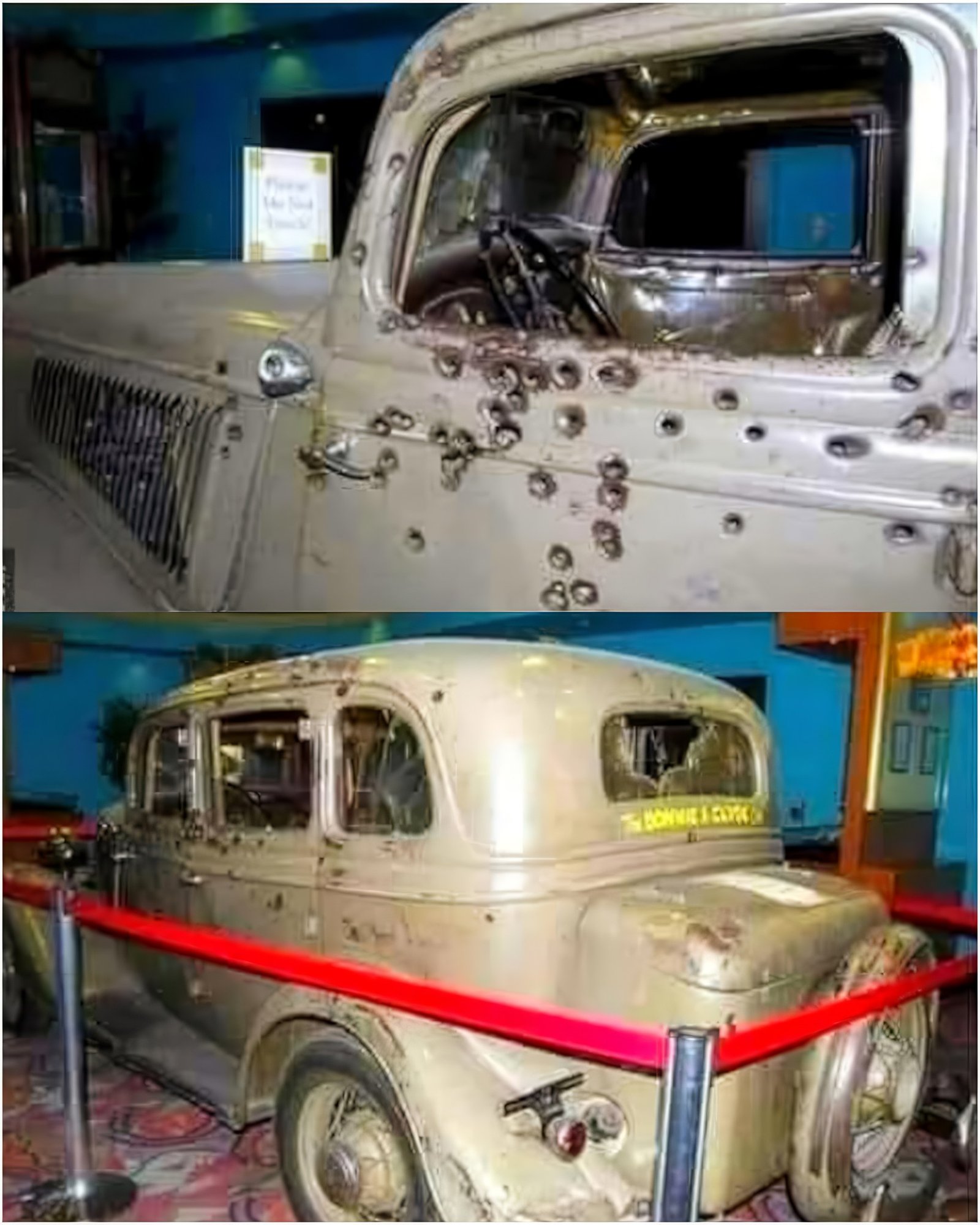
Car riddled with lead: Every inch of the Ford V8 was perforated—spare tire, trunk, radiator, seats—all bearing bullet holes.
-
Survivor bodies: Both died in the front seat; Bonnie’s charred dress and Clyde’s bloodied face told a silent story.
-
Vehicle seized as evidence: Law enforcement towed the car back to Dallas.
In death, the V8 was more than a getaway vehicle—it was a bullet-riddled shrine, a haunting memorial of the outlaws’ final hour.
VII. Post-Ambush Journey: From Proof to Exhibit
A. Public Exhibition & Death Tour
-
Praise for public security: The seized car was paraded across Texas. Large crowds filed past, gawping at the evidence of police victory.
-
Hands-off regulations: Police chained the V8 to secure posts. Inspectors and journalists studied every bullet hole.
-
Tickets for viewing: Most stops charged admission—revenge‑tours for public entertainment.
B. Legend and Headlines
Papers called it the “death car,” using the image of the bullet-ridden V8 to dramatize the wild careers of Bonnie and Clyde. Headlines screamed about their demise and the metal testimony to justice.
VIII. The Ford V8 in Popular Imagination
Over decades, this machine transcended its grim origins to become a cultural icon.
A. Films and Literature
-
“Bonnie and Clyde” (1967): Though using a 1934 ½ Ford (a subsequent model), the film echoed the real V8’s design. In the movie’s climactic ambush, the car is saluted as a character.
-
Books and Memoirs: Historians and authors referenced the bullet-riddled Ford V8 as tangible proof of violent lawlessness woven through Depression‑era hardship.
B. Museums and Replicas
-
Crime museums: A surviving replica—complete with bullet breaches—featured in exhibits showcasing outlaw lives and grim realities of gunfights.
-
Automotive histories: The Ford V8 shows up in classic-car clubs, acknowledged as “the getaway car that fought the law until the law fought back.”
C. Cultural Symbol
It became shorthand for unyielding violence, fleeting fame, and the collision between glamour and legality during one of America’s most turbulent decades. It stands in metaphors—fast, broken, glorified, and damned.
IX. Technical Forensics: Dissecting the Ambush Car
Years after the ambush:
-
Forensic bullet mapping: Ballistics experts recreated the scene using surviving photographs to determine angles and firepower used.
-
Preservation and corrosion: The V8’s interior underwent chemical stabilization to preserve bullet crater edges; leather and metal held ghost impressions.
-
Audio reenactments: Some museums used soundscapes—crickets, distant engines, punctured metal—to recreate the moment the V8 was raked with fire.
X. The V8’s Place in True Crime Culture
The car didn’t just belong in newspapers or police archives—it became integral to how Americans told stories about crime.
-
True crime documentaries featured close shots of the bullet-riddled hood and windscreen as narrative pivots.
-
Photographic exhibitions juxtaposed Bonnie’s smile in old snaps with the horror of the car’s final ride.
-
Gangs and romanticization: For later generations, the image of the Ford V8 fell into mythic mourning—gratification at their end, attraction to the outlaw mystique.
XI. Automaker Response and Civilian Ownership
Ford Motor Co. eventually created an insurance claim for the destroyed car—it wasn’t their policy, but they provided documentation. Civilian fans collected bullet-hole souvenirs: dash fragments, tire rims, even parts of the fender became collector items.
This raised legal issues:
-
Laws forbade souvenirs from crime scenes.
-
Some pieces ended up in personal collections; others disappeared forever.
XII. Replicas, Restorations, and Ethical Questions
A. Replica Culture
Auto restorers built replicas of the “death car,” replicating bullet-holed sheet metal using photo references. These reproductions toured fetes, sponsoring debates about the ethics of commodifying real violence.
B. Ethical Concerns
-
Glamorizing violence: Critics argued that romanticizing the V8 fueled obsession with violent criminals.
-
Historical perspective: Supporters claimed replicas taught lessons about law enforcement escalation and moral collapse during the Depression.
-
Museums’ approach: Many displayed replicas only with robust contextual information—explaining economic despair, legal breakdowns, and the benefits of law enforcement unity.
XIII. The Ford V8 Legacy—Fast, Deadly, Iconic
A. Automotive Heritage
-
Specialists consider the 1934 Ford V8 a pivotal car—ushering in era of V8 for affordable vehicles.
-
Some historians credit Bonnie and Clyde’s use of the car with boosting its post-war desirability, especially among hot-rodders.
B. Historical Marker
The Epps Bridge over Highway 99 bears a small plaque: “In memory of Bonnie and Clyde and the bullet-riddled 1934 Ford V8, site of their demise, May 23, 1934.”
C. Cultural Memory
-
Every May, crime buffs retrace the ambush by car—often driving vintage Fords, respectfully, with brake lights on.
-
In popular memory, “the Ford V8” means more than Ford—it’s shorthand for the final scene in America’s greatest outlaw saga.
XIV. Final Thoughts: A Car, Two Lives, and National Reckoning
The bullet‑ridden chassis that the police towed from Highway 99 is more than metal and history—it’s a mirror: torn, broken, yet burnished by myth. The 1934 Ford V8 Peugeot became a fast car with a fatal finish.
It reminds us:
-
That power has limits: the V8’s speed couldn’t outrun the trap.
-
That tools reflect the times: a common workhorse became weapon and victim.
-
That history isn’t tidy: crime, economy, and technology collided in that moment.
In the end, the bullet-scarred 1934 Ford V8—funeral wagon and golden relic—remains America’s most famous outlaw car. It carried Bonnie and Clyde into darkness, and then, ironically, into immortality.
Leave a Reply