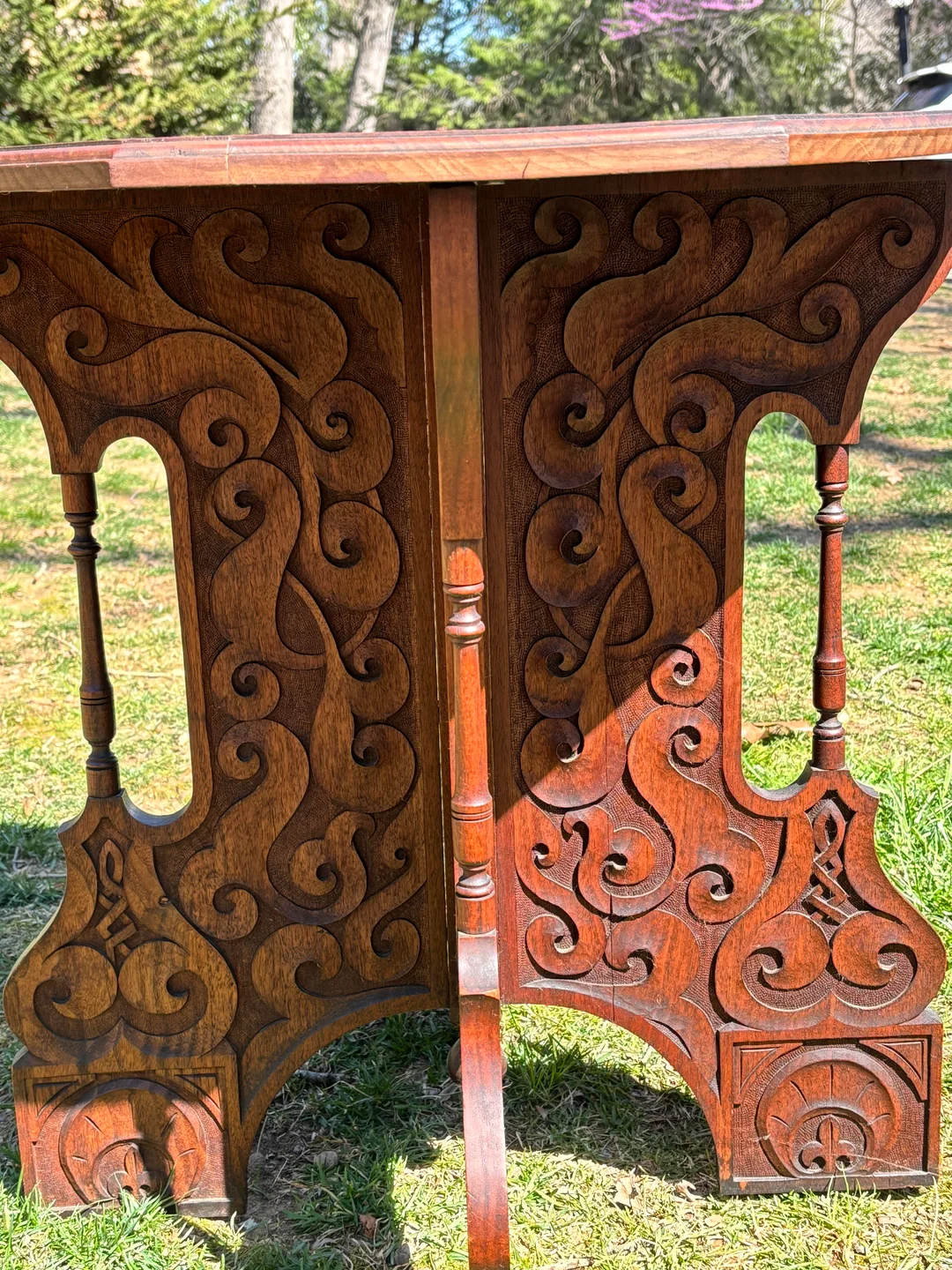
A stunning carved table, said to have been bought in Scotland and shipped to its current location, has caught the attention of many for its intricate design and detailed craftsmanship. The homeowner, fascinated by the piece, has been curious about its origins—specifically, when and where it might have been made. Could it be a Scottish creation, or is there a deeper story to its artistry? The comments and thoughts shared by others shed light on its potential history, offering insight into this exquisite work of art.
The Table’s Design: A Fusion of Cultures
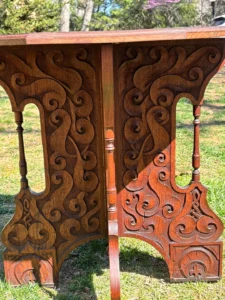
At first glance, the carved table exhibits incredible detail, leaving many to speculate about its origin. The overall aesthetic appears to combine various influences, leading to a variety of theories. Some believe the table was made in Scotland during the Arts and Crafts movement, a period that spanned the late 19th and early 20th centuries. This movement, often associated with the Glasgow School and designers like Charles Rennie Mackintosh, focused on high-quality craftsmanship and artistic designs that were deeply rooted in nature.
Comment 3: “I believe you are accurate! This was created in Scotland during the Arts and Crafts movement, late 19th to early 20th century. Commonly referred to as The Glasgow School, most significant pieces were designed by architect Charles Rennie Mackintosh (1868-1928). It is a very chic, sophisticated style. Great find!”
However, others see influences that suggest it might not be entirely Scottish in origin. Some point to the unique design elements that appear reminiscent of Southeast Asian or Indonesian art, which could indicate the table was imported into Scotland around the turn of the 20th century.
Comment 4: “The design and detail is exquisite!! Does not, at all, look like Scottish design though… I’d wager it was imported there in the late 19th century. Looks South-East Asian in design, though I’m not at all qualified to narrow that down.”
Additionally, the style may not be purely European. Some speculate that the table could reflect a blend of styles, possibly influenced by the rise of Orientalism and the popularity of Turkish or Asian-inspired furniture during the late 19th and early 20th centuries.
Comment 8: “Oriental or Turkish styled smoking rooms for men were popular in the last half of the 19th century, in particular circa 1880, but still could be seen up to the 20s. I think your table would have fit perfectly into one of these oriental styled rooms. I would guess it was made 1880 to 1900. It’s a beautiful table. BTW, to be made or from Scotland, not everything has to be Celtic, tartan, or shortbread.”

Celtic Revival Influence
A more compelling theory that blends both Scottish and international design elements is the idea that the table is a product of the Celtic Revival, a movement that gained momentum in the late 19th and early 20th centuries. The intricate swirls and knotwork present on the table are strikingly similar to patterns found in Iron Age Celtic art, particularly those seen in Ireland and Scotland.
Comment 6: “The design features may look more Asian at first but I think they’re actually inspired by Iron Age Celtic designs—eg look for online Iron Age Celtic gold work found in Ireland and Scotland. So it could be a Scottish Celtic revival piece. Eg the swirls (google ‘iron age pattern’), the torc-shaped moon (torcs are a crescent-shape necklace of the time), the Celtic knotwork reminiscent of illuminated manuscripts.”
These Celtic motifs, such as swirls, knotwork, and crescent-shaped designs, were often revived in the late 19th century as part of a broader movement to reconnect with Scotland’s past. It’s possible that the table was made as a tribute to this Celtic heritage, combining traditional Scottish elements with the other artistic influences of the time.
The Material: Wood and Craftsmanship
The table’s wood, believed to resemble old-growth teak, also raises questions about its provenance. While the wood’s density and grain suggest it might have been sourced from Southeast Asia, it’s clear that the craftsmanship is exceptional, regardless of the geographical origin. The sharp carving on the edges of the table’s surface indicates that it was likely crafted in the 20th century, as the precision and sharpness of the carvings do not appear to belong to an older piece.
Comment 7: “It resembles old growth teak in terms of grain and density, but I agree it has some Celtic and Scottish influence. Those carved edges on the top sure are nice and sharp for an old table, so I think it may be more recent than the late 1800s. It’s great looking, either way, and I’d call it a cocktail or game table without knowing the height. Game table low, cocktail table high. Really high? Barstool for a big-ass Scotsman.”
Preserving the Table
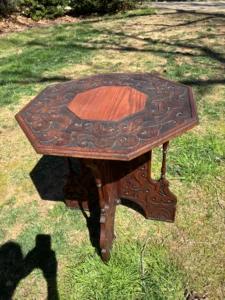
For those who appreciate the artistry of the table, it’s suggested that a custom piece of glass could be cut to preserve the top surface, especially given the deep carvings. Protecting the delicate details will allow the table to remain a functional piece of art for years to come, while preserving its history for future generations.
Comment 2: “Because of the deep carved wood on the top, I would get a custom piece of glass cut to preserve the top surface if you use it every day.”
Conclusion: A Unique and Beautiful Find
Ultimately, the origins of the table remain somewhat elusive, but its exceptional craftsmanship and stunning design are undeniable. Whether it was created as part of the Arts and Crafts movement in Scotland, imported from Southeast Asia, or influenced by the Celtic Revival, it remains a beautiful piece of history. With its intricate carvings and unique combination of influences, the table is an extraordinary find that showcases the skill and artistry of the period.
As the comments suggest, the table is not only a great piece of furniture but a conversation starter, blending cultures, histories, and artistic movements in a way that few pieces of furniture can. Whether used as a functional item or simply admired for its beauty, this carved table is sure to remain a treasured piece in any collection.

