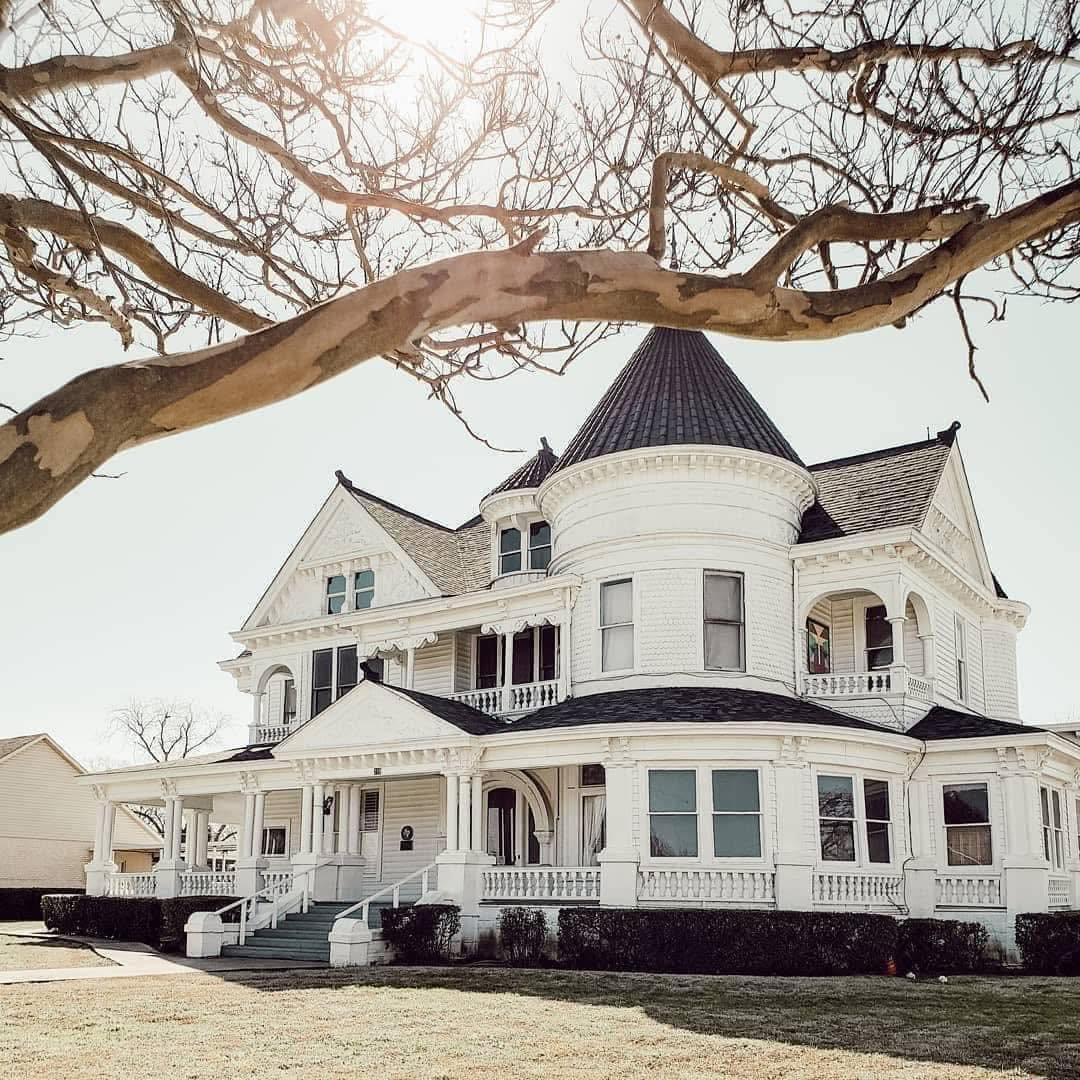
In the heart of Bonham, Texas, stands a grand and stately mansion that commands attention with its soaring tower, wraparound porch, and elegant silhouette.
Known today as the Wise Funeral Home, this majestic structure is one of the last surviving examples of Queen Anne Victorian architecture in Northeast Texas.
Built in 1897, it reflects not only a remarkable architectural legacy but also the enduring story of a town, a family, and a changing era.
A Symbol of Gilded Age Ambition
Commissioned by A. B. Scarborough, a prominent banker and president of the First National Bank in Bonham, the home was conceived during a time of economic optimism.
The late 19th century was a booming period in Northeast Texas. Towns like Bonham were expanding, businesses were thriving, and wealthy residents sought to express their success through architecture.
Scarborough spared no expense. He and his wife were reportedly hands-on during construction, ensuring that every detail reflected their vision of refinement and prosperity.
The home became a symbol of status and elegance, a showpiece that announced both civic pride and personal achievement.
Architectural Brilliance: Late Queen Anne Elegance
The mansion is a masterclass in Queen Anne style, but with notable regional adaptations. While it shares similarities with designs by national pattern-book architects like George F. Barber, the detailing suggests the hand of a regional architect, likely from a city like Dallas, Austin, or Houston.
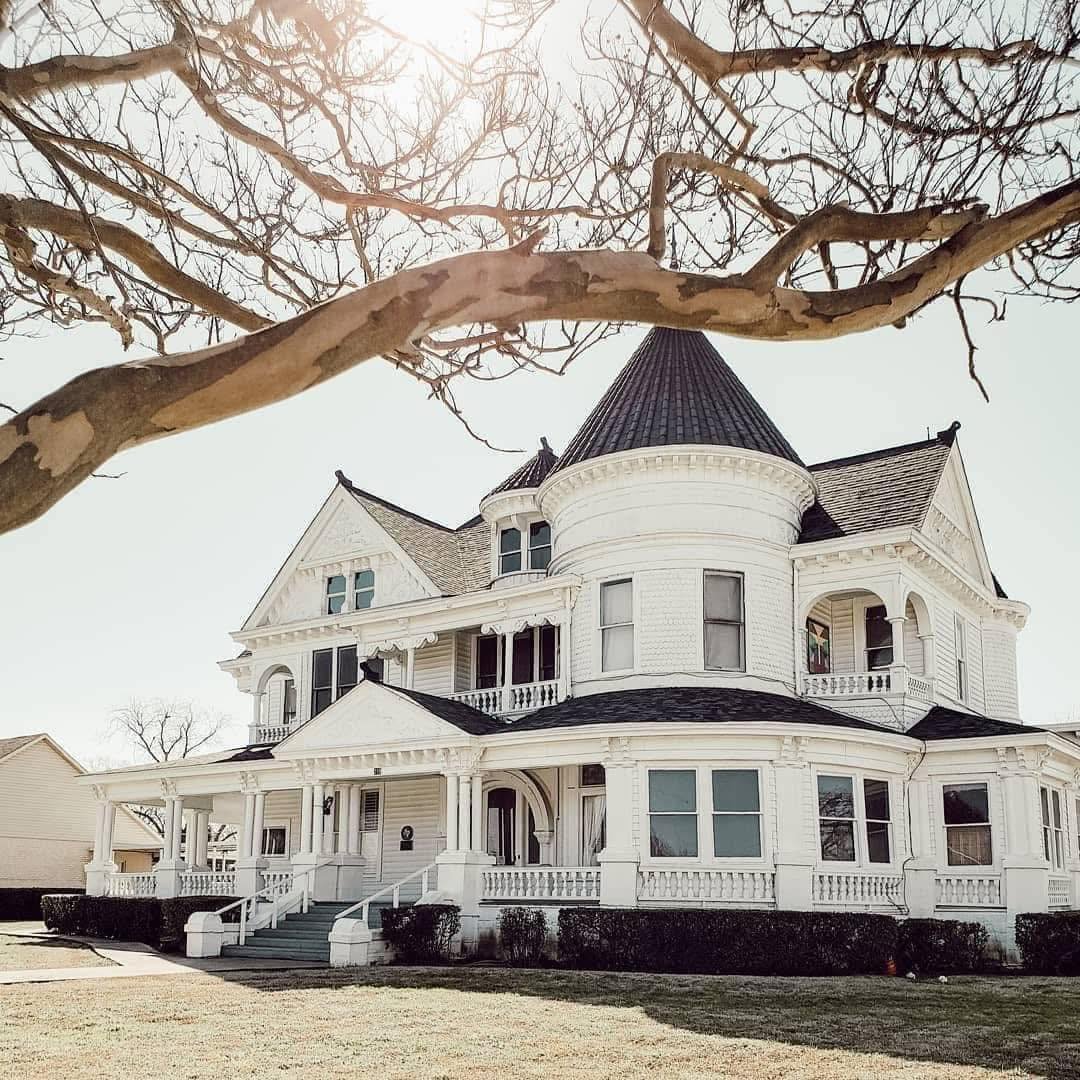
Classic Queen Anne elements are everywhere: asymmetrical massing, steeply pitched roofs, and a soaring round tower capped with a conical roof.
The house is adorned with multiple gables, decorative dormers, and a dramatic wraparound porch supported by pairs of Tuscan columns.
Ornamental brackets, dentil molding, and elaborately carved woodwork offer further decoration without excess, keeping the house balanced and dignified.
In addition to Queen Anne motifs, the home also incorporates Romanesque influences—arched window frames, squat stone columns at the entry, and heavy cornices that give the building a grounded, almost fortress-like quality.
These features temper the more whimsical Victorian elements, lending the mansion a gravitas that seems fitting for its later life as a funeral home.
Interior Splendor and Imported Craftsmanship
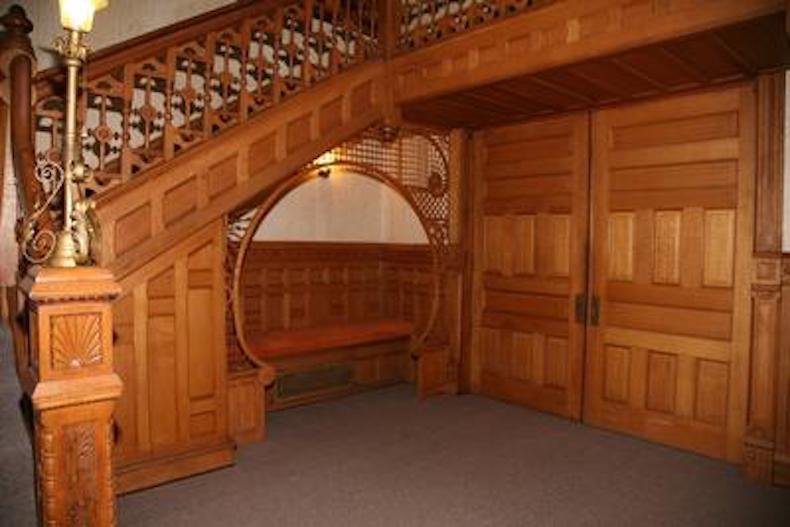
The home’s beauty is not limited to its exterior. Inside, the Scarborough mansion is filled with hand-crafted details that reflect the era’s obsession with luxury and artistry.
Much of the woodwork—staircases, mantels, and built-in cabinetry—was carved from oak, mahogany, and maple, and brought in from out of state, likely from furniture and millwork hubs such as St. Louis.
The floors of the library are laid in intricate parquet, forming elegant geometric patterns out of dark and light woods. There are four exquisite stained-glass windows throughout the home, each casting jewel-toned light into the rooms they adorn.
Nine fireplaces warm the structure, several with multi-room functions. One three-way fireplace connects the foyer, library, and parlor, a rare and luxurious feature even for homes of this scale.
Another remarkable space is found on the third floor—a wide, open attic that was originally intended as a roller-skating parlor for the children. It speaks volumes about the home’s original purpose as not just a symbol of wealth but as a place of comfort, leisure, and family life.
From Mansion to Memorial: A New Chapter
The mansion remained in the Scarborough family until the 1930s, when it was purchased by the Wise family and repurposed as a funeral home.
In 1935, the Wise Funeral Home relocated from downtown Bonham into the spacious and dignified rooms of the Scarborough house, beginning a new chapter in its history.
The home has served in this capacity for nearly a century now, offering solace and ceremony to generations of Fannin County families. Its elegant, solemn beauty makes it an appropriate setting for remembrance and reflection.
The transformation from private residence to public service has also ensured the building’s continued upkeep and preservation, allowing it to survive when so many similar structures have been lost.
One of the mansion’s most historically significant moments came in 1961, when it hosted the funeral of Sam Rayburn, the long-serving Speaker of the U.S. House of Representatives and one of the most influential politicians in American history.
Attendees reportedly included Presidents John F. Kennedy, Lyndon B. Johnson, Dwight D. Eisenhower, and Harry S. Truman. The house thus became not only a local landmark but a footnote in national history.
Dignified Design: The White Façade
Today, the house is painted white with a black roof—colors that were likely not part of the original Victorian palette.
Queen Anne homes of the 1890s were typically painted in vibrant combinations of terra cotta, sage, maroon, and gold, meant to highlight the intricate textures and surfaces.
The current monochrome scheme, however, is fitting for its modern role as a place of quiet dignity.
Though the white paint conceals some of the architectural details that would otherwise stand out in contrasting colors, it brings a stately serenity to the structure.
Its visual calm contrasts with the vibrant past, yet complements the present function—a building where people gather not to celebrate life’s beginnings but to honor its close.
A Survivor in Northeast Texas
At the turn of the 20th century, Bonham and other Northeast Texas towns boasted a number of grand Victorian homes, built by bankers, doctors, cotton merchants, and lawyers.
But time, weather, and changing social patterns have not been kind to these structures.
The sheer cost of maintaining such large homes—particularly ones that originally required full-time staff—proved unsustainable for most families.
As a result, the Scarborough-Wise House stands today as one of the last of its kind. It is not only the finest Victorian house in Bonham, but one of the best-preserved examples in the entire region.
Its survival is due in large part to its adaptive reuse and the dedication of families who have owned and operated it with care.
Historic Designation and Community Legacy
The home was designated a Recorded Texas Historic Landmark in the 1960s, a recognition that ensures some protection and acknowledgment of its architectural and cultural significance.
The plaque on the front lawn is a silent but powerful reminder of the building’s role in Texas history.
Today, the mansion is not open for regular public tours, but it is admired often by passersby and visitors who come to Bonham’s historic downtown. Its location—just blocks from the courthouse, the Sam Rayburn Library, and the Fannin County Museum of History—places it within the heart of the town’s heritage district.
Conclusion: A Living Monument
The Scarborough-Wise House is more than just a building. It is a living monument to the ambitions of a bygone era, the artistic craftsmanship of the late 19th century, and the quiet dignity of modern-day remembrance.
Its tower still rises above the tree line, its windows still glow with colored light, and its porch still welcomes all who walk past.
In an age when so many architectural treasures have been lost, the survival of this mansion is both a miracle and a model. It proves that history can be preserved, adapted, and reimagined—so long as people care enough to protect it.
For the people of Bonham, this house is not just a landmark. It is a part of their shared story—a castle of memory in the heart of a small Texas town.